
Why Paper Patient Records Are Costing Your Health Facility More Than You Think — And What to Do About It
Manual record keeping in health facilities across Africa is not just inconvenient — it is actively harming patient outcomes and draining operational budgets. Here is a practical breakdown of the problem, and how digital records change everything.
The paper problem is bigger than you realise
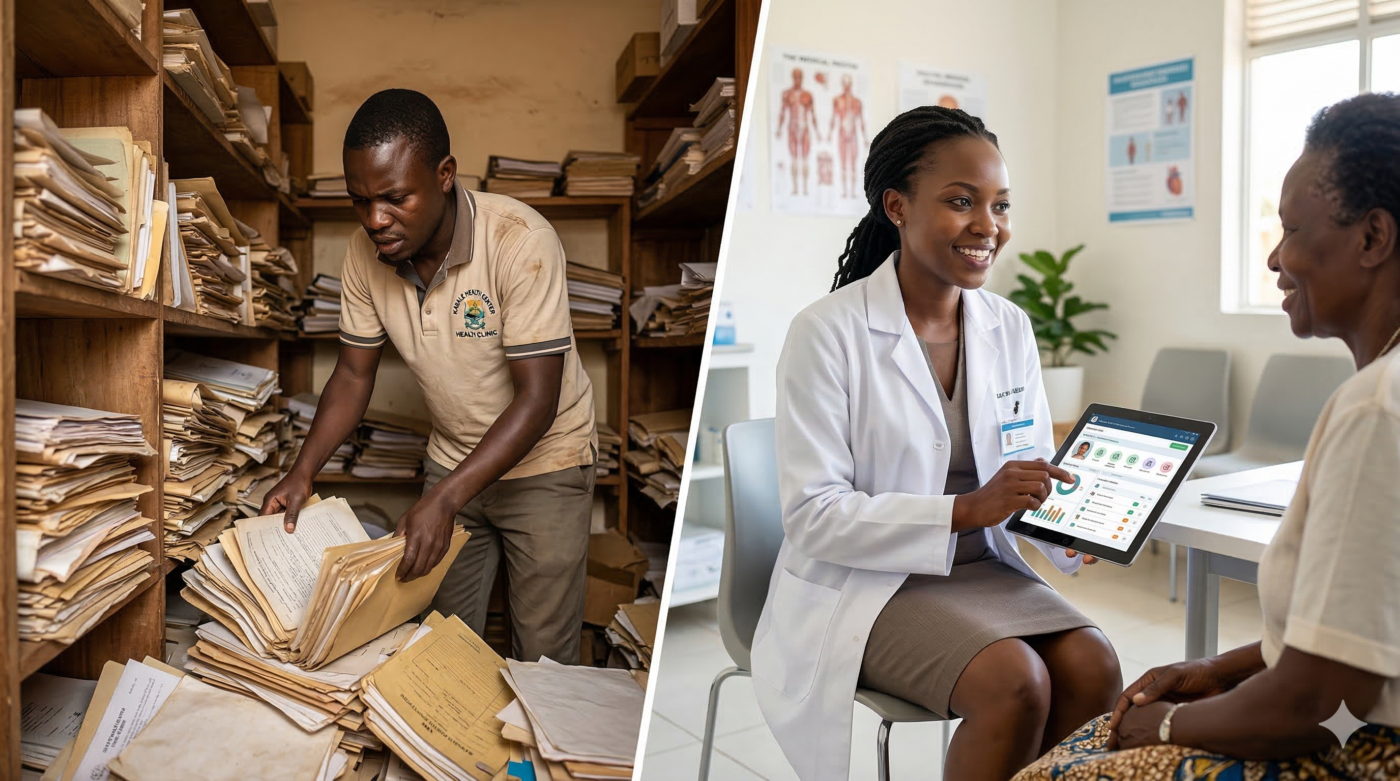
Walk into most health facilities across sub-Saharan Africa and you will find the same scene: stacks of yellowing patient files, overcrowded filing cabinets, and nurses spending 30 minutes hunting for a folder that may or may not exist. This is not a minor inconvenience — it is a systemic failure that puts patients at risk every single day.
According to the WHO Global Patient Safety Report 2024, more than one in ten patients experiences harm in medical care settings — and half of those incidents are preventable. The burden falls disproportionately on low- and middle-income countries, with an estimated 134 million adverse events contributing to 2.6 million deaths each year in LMICs. Inaccessible, incomplete, or missing patient records are a key driver of this crisis.
What goes wrong with manual records — and when
1. Information does not travel with the patient
A patient admitted to the emergency ward may have visited the outpatient clinic three weeks ago with the same complaint. Without a connected record, the attending doctor has no way of knowing. They order the same blood tests, waste time, waste money, and potentially prescribe a drug that conflicts with what was dispensed weeks earlier.
The WHO Global Patient Safety Action Plan 2021–2030 identifies the lack of integrated, accessible health records as one of the most significant structural barriers to safe care in lower-income settings — and calls on health facilities to accelerate the adoption of electronic health records as a priority intervention.
Research shows that half of documented adverse event cases in LMICs could have been avoided simply by having a readily available medical record that proactively supports clinical decision-making. — WHO Global Patient Safety Report 2024
2. Data gets lost, damaged, or tampered with
Paper records are vulnerable in ways digital systems simply are not. Floods, fires, rodents, and ageing infrastructure destroy files. Handwriting becomes illegible. Pages go missing. In some cases, records get altered with no audit trail and no backup. The WHO's Medical Records Manual for Developing Countries acknowledges these physical vulnerabilities and has long recommended the transition to computerised systems as the most reliable path forward.
3. Reporting becomes a nightmare
Health facility managers who need to understand disease trends, track referral outcomes, or report to the Ministry of Health face a monumental task when all data lives in physical files. According to the WHO 2024 findings, only one quarter of countries fully integrate patient safety indicators into their health information systems — a gap driven largely by the absence of digital records at the facility level.
How Streamline solves this
Streamline EMR was built specifically for the realities of health facilities in Africa. It works online, offline, and in hybrid environments — meaning even facilities with intermittent internet connectivity can maintain complete, real-time patient records without interruption.
Every patient visit, diagnosis, prescription, and test result is captured digitally and instantly accessible across departments. When a patient moves from outpatient to inpatient, their record moves with them. The system includes built-in patient safety prompts — automatic clinical reminders that flag key diagnostic and treatment practices — as well as prescription support in the patient's preferred language, improving medication adherence across multilingual communities.
Streamline also integrates with Streamline SNAP for supply tracking and Streamline Pay for billing — meaning the patient record, the clinical notes, and the financial transaction all live in one connected system.
Streamline has already facilitated over 2 million patient visits across 100+ health facilities in Uganda. Facilities report going fully live within approximately one week of implementation. See our clients →
Ready to go paperless?
Book a free demo with the Streamline team and see how your facility can be fully live on a digital EMR in as little as one week.
Book a demo →