
From UGX 2,000 to Full Care: Inside the Community Health Insurance Model Closing Uganda’s Healthcare Access Gap
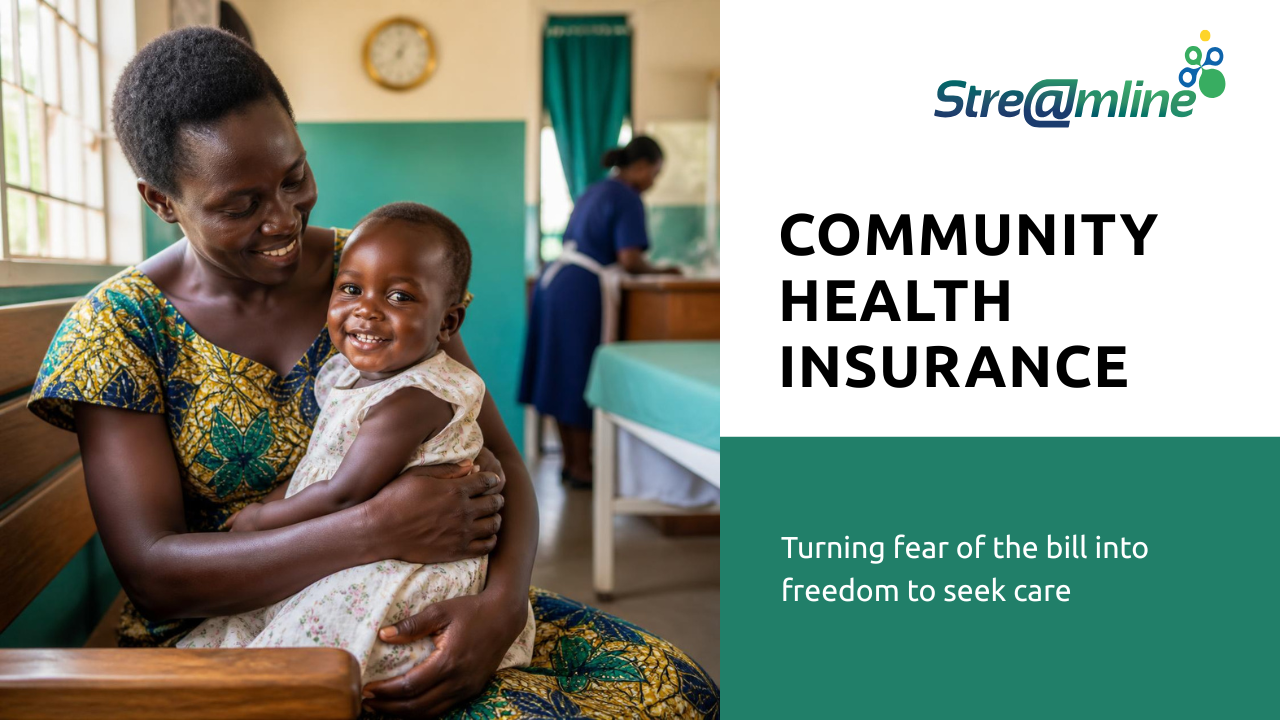
A mother watches her child start coughing. She knows the child needs to see a doctor. But she also knows what that visit will cost — consultation, tests, medicine, each billed separately, each paid out of her own pocket. So she waits. She hopes it passes. By the time she finally brings the child in, the simple cough has become something much harder to treat.
Thank you for reading this post, don't forget to subscribe!This is not a rare story. It is the daily reality for millions of families across Uganda, and it is exactly the problem that One World Health Kijunjubwa in Masindi set out to solve when it adopted the Community Health Insurance (CHI) module on the Streamline platform.
The Real Cost of “Pay As You Go” Healthcare
Out-of-pocket payment is still the dominant way health services get financed across Sub-Saharan Africa. As of 2021, well over half of countries in the region were funding more than 30% of their total health spending directly out of patients’ pockets, and the burden on individual households is severe. One regional study tracking Malawi, Tanzania, and Uganda found that by 2016, out-of-pocket spending exceeding 10% of a household’s budget was affecting over 15% of Uganda’s population — and once a household is pushed into that kind of catastrophic spending, more than a quarter of them fall into it again in the following period.
Uganda’s Ministry of Health has flagged this as a national priority, committing under its 2025–2030 Health Compact to reduce the country’s reliance on out-of-pocket payments and shield households from the catastrophic and impoverishing health costs that push families into, or deeper into, poverty.
Behind every one of those statistics is a version of the same story playing out at OWH Kijunjubwa: patients who could not afford even the smallest routine payment simply stopped coming — until they had no choice, and arrived at the facility already in a bad condition.
Why One World Health Kijunjubwa Turned to CHI
One World Health’s mission is to extend healthcare access as widely as possible. But a mission alone doesn’t remove a shilling amount from a hospital bill. The facility kept running into the same tension: patients wanted care, the facility wanted to provide it, but the point-of-care, pay-per-visit model was quietly locking a large share of the community out. Some patients simply could not afford even the slightest payment every time they came to hospital — and that was enough, on its own, to stand between them and the care they needed.
The second, quieter cost was fear. Patients avoided routine checkups altogether, not because they didn’t recognise the symptoms, but because they dreaded the bill attached to finding out what was wrong. By the time many arrived at the hospital, a manageable issue had become a complicated — and more expensive — one to treat.
How the CHI Module Changes the Equation
This is the exact gap Streamline’s CHI (Community Health Insurance) module was built to close, and it’s now live and running at OWH Kijunjubwa.
Instead of pricing care per visit, per test, and per prescription, CHI restructures the patient’s relationship with cost entirely. Picture the scenario: a child starts coughing, and instead of weighing up a stack of separate, unpredictable bills, the parent knows medical care is covered at a flat 2,000 UGX. The child can be taken in, every necessary test can be run, all for that same 2,000 UGX. Structured like a familiar insurance scheme but built around the routine, everyday healthcare needs of the community it serves, CHI turns an unpredictable, often-avoided expense into a small, plannable one.
In practical terms, the CHI module gives a facility like OWH Kijunjubwa the tools to:
- Enroll and manage members under a locally customised premium and benefits structure, rather than a generic insurance template.
- Pre-authorize and process claims digitally at the point of care, so a covered patient’s visit doesn’t stall at the cashier’s window.
- Track utilisation in real time, giving facility leadership visibility into how members are using their cover — and where the scheme needs to flex.
- Remove the manual, paper-based reconciliation that typically makes community health insurance schemes difficult for small facilities to sustain on their own.
The result is a scheme that feels, to the patient, like a fixed, low-cost membership — while giving the facility the administrative backbone to run it sustainably, without hiring a dedicated claims team.
Why This Matters Beyond One Facility
OWH Kijunjubwa’s experience is a small-scale illustration of a much larger continental pattern. Across the 100+ health facilities already running on Streamline, community health insurance has proven to be one of the most practical bridges between a facility’s ambition to serve its community and a patient’s actual ability to pay. The Streamline Ubuntu CHI product alone already connects over 75,000 active subscribers to hospitals across Uganda — proof that affordability and quality of care are not opposing goals when the right systems are in place.
It doesn’t require a national insurance rollout or years of policy reform — it requires a facility with the will to protect its patients from catastrophic cost, and a digital system that can make the scheme operationally sustainable. That second piece is where most CHI schemes in the region quietly fail, and it’s precisely the gap Streamline’s CHI module is designed to close.
Streamline’s Role: Building the Rails, Not Just the Software
At Streamline, our tagline is simple: we take care of the data, so medics can take care of patients. The OWH Kijunjubwa rollout is that philosophy in practice. OWH Kijunjubwa brought the mission and the willingness to rethink how patients pay for care. Streamline brought the digital infrastructure — the same Streamline EMR and CHI backbone already supporting 100+ health facilities across East Africa, alongside cashless Streamline Pay processing — to make a community-priced insurance scheme operationally viable for a facility of this size.
This is the pattern we’re seeing repeat across our partner network: mission-driven facilities know exactly what their communities need. What’s often missing is the system to run it at scale without breaking under manual processes. That’s the layer Streamline exists to provide.
The Bigger Picture: Affordable Care Is a Systems Problem
The story out of Masindi is, at its core, a systems story. A child’s cough shouldn’t be the moment a family calculates whether they can afford to find out what’s wrong. Community health insurance, properly implemented, removes that calculation. But it only works if the technology behind it removes friction rather than adding to it — if enrolment, claims, and record-keeping happen in the background instead of becoming a second barrier to care.
That’s the standard OWH Kijunjubwa and Streamline set out to meet together — and it’s the same standard we bring to every health facility we partner with across the region.
Is your facility exploring a community health insurance scheme, or struggling to make an existing one operationally sustainable? Talk to the Streamline team about how our CHI module, built alongside EMR and cashless payments on one platform, can help you extend affordable care to more of your community.