
Choosing the best EMR platform in Africa is one of the most consequential decisions a hospital can make. The wrong choice means expensive foreign software that does not fit local workflows, no local support when things go wrong, and a system that staff abandon within months. Here are 10 proven reasons why Streamline stands apart.
Thank you for reading this post, don't forget to subscribe!Why the Best EMR Platform in Africa Must Be Built for Africa
The best EMR platform in Africa cannot simply be a Western system transplanted into an African hospital. The realities are too different. Africa's digital health market is growing at 23.4% annually — but this growth is being driven by solutions purpose-built for the continent's specific infrastructure, budget, and workflow constraints. Unreliable internet, large patient volumes, multilingual staff, Ministry of Health reporting obligations, and mobile money payment ecosystems are not afterthoughts — they are the daily operating environment of every African health facility.
Streamline Health Tech Ltd, developed in Uganda and recognised by the International Finance Corporation and World Bank Group as one of the top 20 companies addressing East Africa's health challenges, was built to meet those realities head on. Here are the 10 reasons it is consistently selected as the best EMR platform across Africa.
Why Streamline Is the Best EMR Platform in Africa: 10 Proven Reasons
1. Full end-to-end hospital integration
Streamline connects every department under one platform: patient registration, outpatient and inpatient consultations, triage, investigations, laboratory, pharmacy and stock management, finance, theatre, and specialised clinics. This end-to-end integration eliminates data silos — a chronic problem in hospitals that use separate systems for clinical and administrative functions. Whether you manage a large referral centre or a small private clinic, every team works from the same real-time data.
2. Built for Africa, customisable for any facility
Healthcare needs vary widely across the continent. A mission hospital in rural Uganda has different workflows from a large teaching hospital in Lagos or a private clinic in Nairobi. Streamline is designed to adapt — same platform, configured to the specific requirements of each facility. This flexibility is what makes it genuinely the best EMR platform in Africa rather than just the best in one context.
3. 10,000+ patient safety prompts embedded in clinical workflows
Patient safety is not a separate feature — it is woven into every clinical interaction. Streamline's 10,000+ patient safety prompts alert clinicians to drug interactions, contraindications, abnormal results, and evidence-based treatment protocols at the point of care. This is especially critical in high-volume settings where staff-to-patient ratios are stretched and the risk of error is elevated. The WHO estimates half of all adverse events in low-income settings are preventable — and accessible clinical decision support is one of the most direct ways to prevent them.
4. Clinical knowledge resources at the point of care
Medical reference tools are embedded directly in the system, giving clinicians and nurses immediate access to drug references, diagnostic guidelines, and treatment protocols without leaving the patient record. This supports better decision-making and serves as a continuous learning tool for staff — particularly valuable in facilities where formal continuing education is infrequent.
5. Automatic HMIS reporting — no manual tallying required
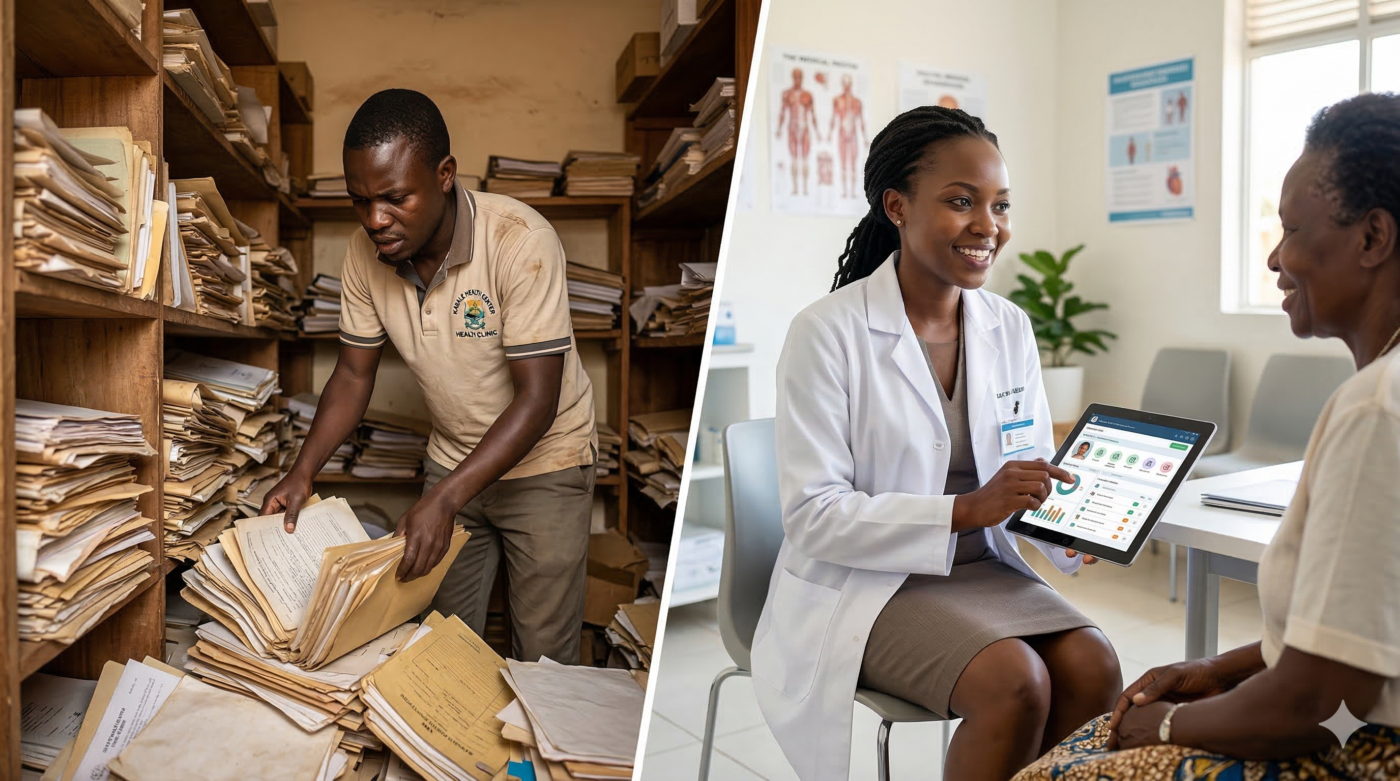
Completing Uganda Ministry of Health HMIS reports manually is one of the most time-consuming and error-prone tasks in any health facility. Data clerks spend hours tallying entries from multiple registers to fill forms that are often submitted late and riddled with inaccuracies. Streamline generates all required HMIS reports automatically from data already captured in the system — weekly, monthly, quarterly, and annual reports are ready with a few clicks. The accuracy is 100%, submissions are on time, and data clerks are freed to do more meaningful work.
6. Triple backup — your data is always safe
Paper records are destroyed by fire, floods, and simple misplacement. Hard drives fail. Streamline uses a triple backup system that protects facility data against hardware failure, natural disasters, and cyber threats simultaneously. This level of data security and continuity is a major step forward for health facilities that previously had no reliable way to recover lost records.
7. Genuinely easy to use — designed for all skill levels
One of the most common reasons EMR implementations fail across Africa is staff abandonment. Systems that require extensive computer literacy or lengthy training are rejected by clinical staff who are already under pressure. Streamline is designed with simplified workflows, dropdown menus, fast search, and logical navigation that makes it intuitive for staff with basic computer skills. Most facilities report full staff adoption within the first week of going live.
8. Priced for African budgets
International EMR systems designed for North American or European hospitals are priced far beyond the reach of most African facilities. Streamline's pricing is scaled to facility size and user count, with a flexible model designed for resource-constrained settings. This is not a cut-down version of a premium product — it is a full-featured platform priced to be accessible to the hospitals that need it most.
9. Local support, local team, local understanding
Support is where many otherwise good EMR systems fail in Africa. When a foreign system goes down, help is in a different time zone, speaks without understanding the local context, and arrives days later. Streamline's support team is locally based — physically present and reachable. Both on-site and remote support are available, and the team understands Ugandan and East African healthcare realities from direct daily experience.
10. Real-time data for better decisions at every level
The best EMR platform in Africa should not just record what happened — it should inform what happens next. Streamline generates real-time, clinician-driven data that supports evidence-based patient care, national health reporting, and donor-funded programme monitoring. Administrators have a live view of income, stock levels, patient volumes, and departmental performance. Ministry reports are accurate. And facility owners can finally make decisions based on what is actually happening in their hospital, not on last month's handwritten summary.
Streamline is recognised by the IFC and World Bank Group as one of the top 20 companies addressing East Africa's health challenges — the only EMR platform on that list developed entirely in Uganda, for Africa. See our clients →
What Happens After You Go Live with Streamline
Implementation is one of the most common concerns for health facilities considering their first EMR. With Streamline, most facilities are fully live within one week. The onboarding process includes staff training, data migration support, and configuration to match the facility's specific workflows and departments. After go-live, the local support team remains available for ongoing assistance, system updates, and new feature rollouts.
Facilities that have moved to Streamline consistently report three immediate changes: clinical staff spend less time on paperwork and more time with patients, financial visibility improves dramatically within the first month, and Ministry of Health reporting becomes a routine task rather than a monthly crisis. Over time, the data generated by the system becomes one of the facility's most valuable assets — informing procurement decisions, staffing allocation, and strategic planning in ways that were simply not possible with paper.
Ready to see Africa's best EMR platform in action?
Most facilities go live in under a week. Book a free demo with the Streamline team and see exactly how the platform fits your facility's workflows and budget.
Book a free demo →